Beyond the Hype: Building AI Agents That Actually Work in Production

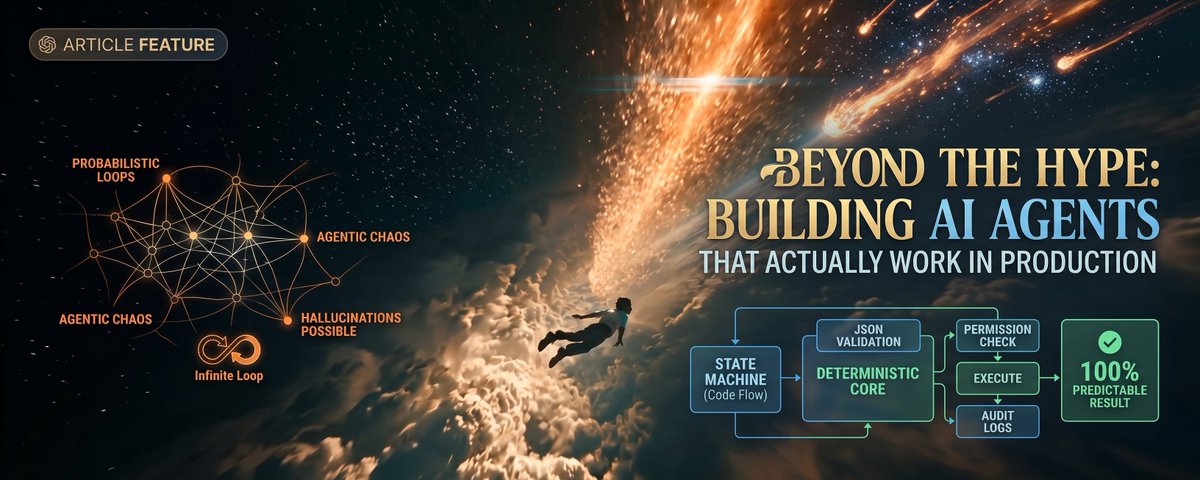
We’ve all seen the magical AI demos. You type a vague prompt into a chat box, and a few seconds later, an "autonomous agent" writes a marketing plan, codes a website, and emails a client. It looks like the future of work has arrived.
But when teams try to build these systems for real users, they hit a wall.
The agent works perfectly in the demo, but in production, it loops endlessly, calls the wrong API, hallucinates data, and fails about 20-30% of the time. In software engineering, an 80% success rate is not a feature; it’s a catastrophic bug.
The problem isn't that the AI isn't smart enough. The problem is how we are building the systems around it. The industry is rapidly shifting away from "Probabilistic Agentic Loops" (where the AI is entirely in charge) toward a "Deterministic Core" (where traditional code is in charge, and the AI is just a tool).
Here is a deep understanding of why this shift is happening and how to build AI agents that actually work at scale.
The Root Problem: Probabilistic vs. Deterministic
To understand why early AI agents fail in production, we need to understand the difference between probabilistic and deterministic systems.
- The Probabilistic Loop (The "Demo" Way)
Large Language Models (LLMs) like GPT-4 or Claude are probabilistic. They don't "think" in logic; they calculate the statistical likelihood of what word should come next based on their training data.
In early agent architectures (like AutoGPT), developers put the LLM in charge of the Control Flow.
- Prompt: "Book a flight and a hotel."
- LLM Decides: "I should search for flights first."
- LLM Acts: Uses a search tool.
- LLM Decides: "Now I should book it."
The LLM is running a constant while(true) loop in its own "brain." Because the LLM is probabilistic, its decisions change slightly every time. If it gets confused, it might search for flights over and over again in an infinite loop, or it might decide to book a hotel in the wrong city because it hallucinated a step.
- The Deterministic Core (The "Production" Way)
Business logic demands determinism. A deterministic system operates on fixed rules: if X happens, then do Y. It produces the exact same output every single time. Payroll, database updates, and checkout flows are all deterministic.
The new standard for building AI agents is to wrap the probabilistic LLM inside a rigid, deterministic shell.
Instead of letting the LLM decide what to do next, you write standard software code (like Node.js, Python, or Go) to manage the control flow. The code uses if/else statements and try/catch blocks. It only calls the LLM when it specifically needs the AI's superpower: understanding messy, natural human language.

The "12-Factor Agent" Methodology
In traditional software, developers use the "12-Factor App" methodology to build scalable web apps. Recently, engineers have proposed a similar framework for AI: The 12-Factor Agent.
These principles guide developers on how to tame the chaos of LLMs. Here are the most critical takeaways:
- Own Your Control Flow (Code > Prompts)
Never tell an LLM, "Figure out how to do this task." Instead, break the task down into a rigid state machine.
For example, if you are building an AI customer service agent for your e-commerce platform :
- Don't: Give the LLM access to your database and say, "Help the customer."
- Do: Write code that receives the user's message. Call the LLM with a specific prompt: "Extract the user's intent as JSON: is it a refund, a missing order, or a product question?" Once the LLM returns the JSON, your standard code routes the request to the correct function.
- Tools Are Just Structured Outputs
In AI terminology, a "Tool" is when the AI triggers an action (like sending an email or querying a database).
In a production environment, the LLM should never execute the tool directly. Instead, the LLM should output a structured JSON object (e.g., {"action": "refund", "amount": 50}). Your deterministic code then validates that JSON, ensures the user has permission, and executes the database update.
- Separate Execution State from Business State
LLMs have a "Context Window"—the amount of text they can remember in a single conversation. If an agentic loop runs too long, the context window fills up, the LLM gets confused, and it "forgets" what it was doing.
A production agent must be stateless. The memory of what is happening shouldn't live inside the LLM; it should live in your database.
- Business State: The actual data (e.g., "The order has been refunded").
- Execution State: Where the code is in the process (e.g., "Step 2 completed, waiting on Step 3").
If your server crashes mid-task, your code can look at the database, see that Step 2 was completed, and resume at Step 3 without needing the LLM to remember anything.
Best Architectural Patterns for AI Agents
When you build systems using a deterministic core, specific architectural patterns emerge. These patterns replace the "giant prompt" with structured engineering.
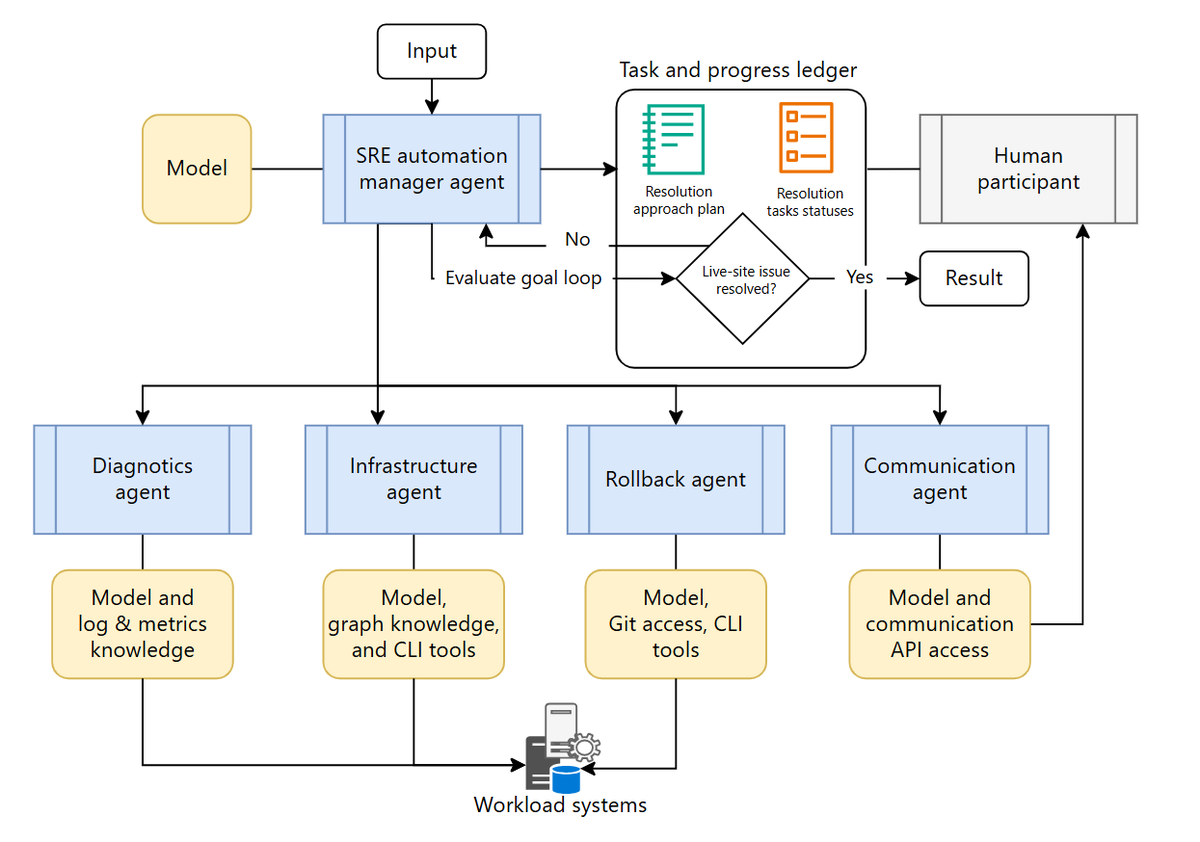
Pattern A: The Supervisor and Specialists (Routing)
Instead of one massive LLM prompt trying to do everything, build a router.
- The Supervisor is a small, fast, cheap LLM. Its only job is to look at the input and decide which specialist to call.
- The Specialists are highly tuned prompts designed for one narrow task (e.g., a "Refund Specialist" or a "Technical Support Specialist").
This is much easier to debug. If the agent gives bad technical advice, you know exactly which specialist prompt to fix.
Pattern B: Two-Phase Actions (Plan → Validate → Execute)
For any action that changes data (like updating a database or spending money), never let the AI act immediately.
- Plan: The LLM proposes an action and formats it as JSON.
- Validate: Your deterministic code checks the JSON against business rules. (e.g., Is the refund amount less than the purchase price?)
- Execute: Only if validation passes does the code execute the action.
Pattern C: Evaluator-Optimizer (LLM-as-Judge)
If a task is highly complex, you can use two models against each other.
- Model A generates a result (e.g., writes a block of code).
- Model B acts as a judge, evaluating the result against strict criteria.
- If Model B finds an error, it sends it back to Model A to fix. Your deterministic code manages this loop and puts a hard limit on it (e.g., "Stop after 3 tries").
Why This Matters For Your Tech Stack
Whether you are building a React Native mobile app or a full-stack MERN platform, integrating AI requires treating the LLM as a component of your system, not the manager of your system.
The Golden Rule of Production AI: Use deterministic logic (code) wherever an outcome must be reproducible on demand. Use probabilistic logic (LLMs) only where interpretation, pattern recognition, and unstructured data create real value.
By moving the control flow out of the fuzzy weights of the language model and into the rigid, testable world of software, you turn unpredictable AI demos into reliable infrastructure. Code doesn't hallucinate. It executes, or it errors—and in software engineering, a predictable error is infinitely better than a confident hallucination.
Have thoughts or questions on this topic?
Follow and discuss with our engineering team on X / Twitter for daily tech breakdowns, system design notes, and software engineering debates.
Related Articles

Your Phone Was Always a Better Remote Control . NEXORA Just Made It Feel Like One
I never noticed how frequently I reached for the mouse until I began keeping count. Lean in, click, lean back, open a tab, skip a track, type six words—and repeat the loop dozens of times an hour. The

Out of a quiet obsession, we built a beast. 60+ heavy utilities, handed freely to the web.
A few months ago, Launch Your Concept released a beast. 60+ massive utilities operating entirely off the grid.. Inside the engineering madness that built FlashTools. We were tired of the web feeling

Designing a Multi-Tenant Tuition System That Scales Without Bloat
How a client who refused to touch a payment gateway forced a leaner, faster architecture than any "best practices" checklist would have produced. My client didn't know what a server was. He'd never