The Ultimate Roadmap to AI Engineering: From Python Basics to Autonomous Agents and Fine-Tuning


The noise in the artificial intelligence ecosystem is deafening. Every day brings a new framework, a new foundational model, and a new buzzword. For software developers and technology enthusiasts looking to transition into AI engineering, this constant churn creates paralysis. Where do you even begin?
If you strip away the marketing hype, the path to mastering AI engineering is actually highly structured and deeply logical. True AI engineering is not just typing prompts into a web interface. It is the discipline of integrating non-deterministic intelligence into deterministic software systems. It involves forcing language models to output strictly typed data, giving them long-term memory, orchestrating them into autonomous agents, and fundamentally altering their neural weights to teach them entirely new behaviors.
This comprehensive guide will walk you step-by-step through the process of becoming an AI engineer. We will cover the foundational mathematics, the exact frameworks you need to learn, the architecture of autonomous agents, the mechanics of fine-tuning, and a progressive portfolio of projects you can start building today.
Phase 1: The Foundations — Mathematics and Mental Models

You do not need a PhD in computer science to build robust AI applications, but you cannot skip the foundational logic. AI is fundamentally a statistics engine, and understanding how it processes information will separate you from developers who merely guess at API inputs.
- The Language of AI: Python

Python is non-negotiable. It is the absolute lingua franca of machine learning, data science, and AI orchestration. If you are coming from JavaScript or C++, you must adapt to Python. The entire ecosystem—from PyTorch and Hugging Face to LangChain and PydanticAI—is built on it.
- The Mathematics of Intelligence

You must understand the core mathematical concepts that allow computers to "understand" human language:
- Vectors and Linear Algebra: AI does not read text; it reads numbers. Words and sentences are translated into high-dimensional numerical arrays called vectors. You need a working intuition of vector spaces, matrices, and dot products.
- Embeddings and Semantic Distance: When a model converts a sentence into a vector, it maps its meaning into a mathematical space. Words with similar meanings are placed close together. To measure how similar two concepts are, AI engineers use Cosine Similarity. The formula measures the angle between two vectors:
A score closer to 1 means the texts are semantically identical.
- Probability and Next-Token Prediction: Large Language Models (LLMs) are highly advanced autocomplete engines. Given a sequence of text, they calculate the probability distribution of the next possible word (or token) using the formula:
Understanding this helps you manipulate parameters like "temperature" (which flattens or sharpens this probability curve to make outputs more creative or more robotic).
- The Architecture: Transformers and Tokens

- Tokens: A token is a chunk of a word. A general rule is that 100 tokens roughly equal 75 English words. Models have strict "context windows" (e.g., 128,000 tokens), meaning they can only "hold" that much text in their active memory at one time.
- Self-Attention: The breakthrough that made modern LLMs possible is the Transformer architecture, specifically the "self-attention" mechanism. Instead of reading text linearly from left to right, a transformer evaluates every word in a sentence simultaneously, scoring how much "attention" each word should pay to every other word to derive deep contextual meaning.
- Free Practice Path Install Ollama → run ollama run llama3.2 or qwen2.5 locally. Practice everything in this roadmap for free before spending a single dollar on APIs.
Phase 2: Application Engineering and API Mastery

Before you attempt to train a model from scratch, you must learn how to hook existing, powerful models (like OpenAI's GPT-4, Anthropic's Claude, or Google's Gemini) into your software.
Prompt Engineering: The Real Starting Point Most people jump straight into frameworks. That is a mistake. The most important skill in AI engineering is learning how to control the model with words. This is called Prompt Engineering or Context Engineering.
You must master these techniques first:
- System Prompt – You tell the model who it is, what rules it must follow, and how it should behave. Few-shot examples – You show the model 2 to 5 perfect examples of what you want. Chain of Thought – You force the model to think step by step by writing “Think step by step before answering”. Clear separation – Always put instructions in one place and data in another place using simple markers like triple quotes or XML tags.
Without good prompting, even the best RAG system or agent will fail. Practice this for at least one week before moving forward.
- Structured Outputs and JSON Validation
The biggest hurdle in AI engineering is that models output unstructured text, but software backends require structured data (like JSON) to function properly.
You must learn how to force an LLM to reply in a strict schema. In Python, the industry standard for this is Pydantic. By defining a Pydantic BaseModel, you can instruct the LLM to map its output directly to your required variables, ensuring your application never crashes due to a malformed response.
- Free Practice Path (Do this first) You do not need to spend money. Install Ollama on your computer. Then run simple models like llama3.2 or qwen2.5 completely free on your own laptop. Practice every concept in this roadmap locally before you ever use a paid API. This removes fear of cost and lets you experiment freely.
Retrieval-Augmented Generation (RAG)

LLMs are frozen in time. They only know what they were trained on, and they will hallucinate (make things up) if asked about proprietary or recent data. The solution is Retrieval-Augmented Generation (RAG).
Here is the step-by-step engineering architecture of RAG:
- Ingestion & Chunking: You take your private data (company wikis, PDFs, codebases) and chop it into smaller, overlapping chunks of text (e.g., 500 tokens per chunk).
- Embedding: You pass these chunks through an embedding model to convert the text into numerical vectors.
- Vector Database: You store these vectors in a specialized database built for high-dimensional math. Popular choices include Pinecone, Qdrant, or PostgreSQL using the pgvector extension.
- Retrieval: When a user asks a question, you embed their query into a vector, run a cosine similarity search against your database, and retrieve the top 3 most relevant chunks of text.
- Generation: You inject those retrieved chunks into the LLM's system prompt and say, "Answer the user's question using ONLY the provided context."
How to Measure If Your System Actually Works Building is easy. Knowing whether it is good is hard. After you build any RAG or agent, you must evaluate it. Use free tools like RAGAS or DeepEval. Check three simple things: Is the answer correct? Is the answer based only on the retrieved context? Is the answer helpful? Never ship a system without measuring these. Later you can use LangSmith or Langfuse for full tracking.
HOW DO YOU KNOW YOUR SYSTEM WORKS? (EVALUATION)
Building an AI application is the easy part; accurately measuring its reliability and performance is the real challenge.
Here are the essential practices every AI engineer uses to evaluate their systems:
Measuring RAG Quality Use specialized evaluation frameworks like RAGAS or DeepEval to rigorously test your Retrieval-Augmented Generation pipelines. Focus on three critical metrics: faithfulness (ensuring the model does not hallucinate beyond the provided documents), answer relevance (ensuring the output directly addresses the user's prompt), and context precision (ensuring your vector database retrieves the correct information).
Evaluating Autonomous Agents When building agentic workflows, you must maintain complete system observability. Automatically log and audit every single tool call, intermediate reasoning step, and final output to identify exactly where execution loops break down or misinterpret instructions.
Observability and Tracing Tools Implement industry-standard tracing platforms to monitor your applications in real time. Use professional tools like LangSmith, Langfuse, or Arize Phoenix (which offers an excellent open-source option) to track latency, token costs, and system accuracy across your entire pipeline.
CORE RULE Never ship an AI application to production without rigorous, automated evaluation and continuous observability tools in place.
Phase 3: Building Autonomous Agents (Agentic AI)

An AI Agent is simply a Large Language Model wrapped in a logical reasoning loop and given access to external tools. Instead of just answering a question, an agent can take actions.
The ReAct Loop (Reason, Act, Observe)
Agents operate autonomously using the ReAct framework:
- Reason: The agent looks at the user's goal and breaks it down into steps.
- Act: The agent executes a tool (e.g., triggering a Python script to scrape a website, query a database, or call an external weather API).
- Observe: The agent reads the result of that tool and decides if it has enough information to fulfill the user's goal, or if it needs to trigger another tool.
Frameworks to Learn
While LangChain and CrewAI are popular, the current modern standard for building robust, production-ready agents in Python is PydanticAI.
PydanticAI is a lightweight framework that treats agents like standard Python functions. It provides deep type safety, runtime dependency injection, and automatic retries if the LLM outputs invalid data. You define tools using a simple @agent.tool decorator, allowing the LLM to call your local Python functions directly.
Phase 4: Model Engineering and Fine-Tuning
APIs are powerful, but eventually, you will hit a wall. Perhaps you need a model to output highly proprietary code syntax that it has never seen before, or perhaps you want to deploy a small, lightning-fast model on your own local hardware to avoid paying high API costs. This is where you graduate to fine-tuning.
The Golden Rule of AI Engineering
- Use RAG for knowledge (giving the model new facts).
- Use Fine-Tuning for form, style, and behavior (teaching the model how to speak or format its tasks).
Parameter-Efficient Fine-Tuning (PEFT) and LoRA
Training a massive 70-billion-parameter model from scratch costs millions of dollars. As an AI engineer, you will use a technique called LoRA (Low-Rank Adaptation).
Instead of changing all the billions of weights in a pre-trained model, LoRA freezes the original model and injects tiny, lightweight matrices into the neural network. Mathematically, instead of updating a massive weight matrix W, LoRA learns two much smaller matrices A and B, such that the weight update is calculated as:
This reduces the computational memory required by up to 90%, allowing you to fine-tune incredibly powerful models on a standard consumer graphics card (GPU).
The Unsloth Framework
For fine-tuning open-source models (like Meta's Llama 3, Google's Gemma, or Alibaba's Qwen), the absolute best tool in the industry right now is Unsloth.
Unsloth optimizes the fine-tuning process, making it 2x faster and using 70% less memory than traditional Hugging Face libraries. It is entirely free and open-source. With Unsloth, you can fine-tune an LLM locally or on a free Google Colab notebook instance in less than an hour.
When using Unsloth, you will adjust vital hyperparameters:
- r (Rank): Typically set to 8 or 16. Controls the size of the injected LoRA matrices.
- lora_alpha: The scaling factor. Usually set to double the rank (e.g., 32).
- learning_rate: How aggressively the model learns. A standard starting point for LoRA is 2 *10^{-4}.
Agent Memory Real agents also need memory. Short-term memory is the current conversation history. Long-term memory is a vector database where the agent can store and later recall important facts from previous conversations. Without memory, every agent starts from zero every time.
Phase 5: Step-by-Step Project Portfolio
Do not get stuck reading theory. To become an AI engineer, you must build systems. Follow this progressive project roadmap.
Project 1: The Deterministic Data Extractor
Goal: Learn how to control LLM outputs.
Setup: Create a Python script using the pydantic and openai (or groq) libraries.
Task: Take a massive, messy block of unstructured text (like a raw email thread). Define a strict Pydantic BaseModel that extracts sender_name, action_items (as a list of strings), and urgency_level (as a boolean). Force the LLM to output only valid JSON matching this schema.
Project 2: The Local Document RAG Engine
Goal: Master embeddings and vector math.
Setup: Use sentence-transformers for creating embeddings and ChromaDB or FAISS for a local vector database.
Task: Write a Python application that ingests 10 of your personal PDF documents. The script must parse the text, chunk it into 500-token segments with a 50-token overlap, embed them, and store them. Then, write a search function that takes a user query, embeds it, retrieves the top 3 chunks via cosine similarity, and passes them to an LLM to generate an answer.
Project 3: The PydanticAI Autonomous Researcher
Goal: Build a multi-step agentic workflow.
Setup: Install pydantic-ai and set up a free API key with an external service like DuckDuckGo or a weather API.
Task: Create an agent using PydanticAI. Write two Python functions: one that searches the web for a topic, and one that scrapes the text of a specific URL. Decorate both with @agent.tool. Give the agent a prompt like, "Research the latest news on quantum computing, read three articles, and write a summary." Watch as the agent autonomously decides to call the search tool, reads the results, loops back to call the scraping tool, and finally synthesizes the report.
Project 4: Custom Code Assistant Fine-Tuning
Goal: Alter a model's foundational weights using LoRA.
Setup: Open a free Google Colab notebook (which provides a free T4 GPU). Install unsloth, trl, and peft.
Task: Export a dataset of your own coding projects, formatted into a JSONL file with "instruction" and "response" pairs. Load an open-source model like Llama-3-8B-Instruct via Unsloth. Set your rank to 16, attach the LoRA adapters, and begin the training loop. Once trained, export the model as GGUF format so you can run it entirely locally on your laptop using an engine like Ollama. It will now write code matching your exact personal style.
Phase 6: Learning Resources and Continuous Adaptation
The AI landscape changes weekly, but the fundamentals remain stable. Here is exactly what you should consume to continue your journey.
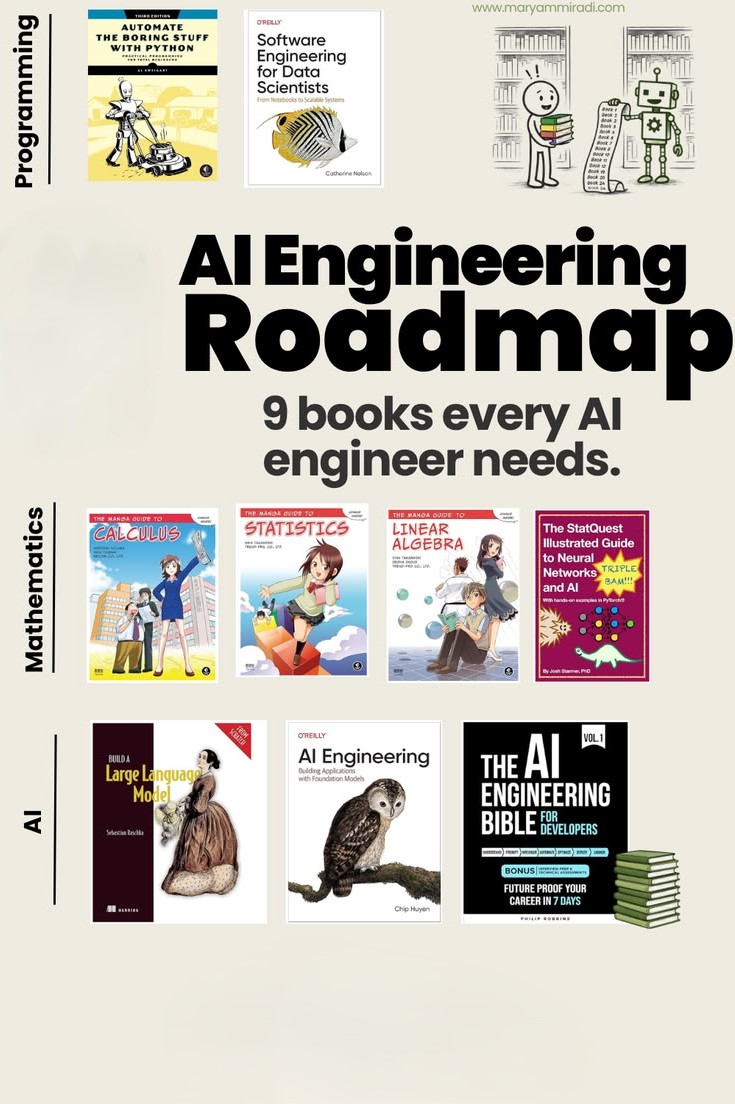
Essential Books:
- Build a Large Language Model (From Scratch) by Sebastian Raschka. This is mandatory reading. It walks you through building a GPT-style model using pure PyTorch, removing all the mystery of how neural networks actually function.
- AI Engineering by Chip Huyen. The definitive guide to taking these systems out of Jupyter notebooks and scaling them securely into production environments.
Video Tutorials & Channels:
- Andrej Karpathy on YouTube: The former Director of AI at Tesla. His "Let's build GPT: from scratch" video and his recent introductory lectures are the gold standard for understanding tokenization, transformers, and model architecture.
- FreeCodeCamp: Excellent for long-form, multi-hour crash courses on LangChain, vector databases, and RAG architectures.
Documentation to Read Cover-to-Cover:
- The PydanticAI documentation.
- The Unsloth GitHub repository and their associated blog posts regarding hyperparameter optimization.
Becoming an AI engineer does not require magic; it requires a deep understanding of data structures, vector mathematics, and API orchestration. Start by mastering Python and structured outputs. Build a solid RAG pipeline. Experiment with agent frameworks to give your models autonomy, and finally, dive into the math of fine-tuning to bend open-source models to your exact will. The tools are free, the compute is highly accessible, and the ecosystem is waiting for developers who know how to build real, resilient systems.
Have thoughts or questions on this topic?
Follow and discuss with our engineering team on X / Twitter for daily tech breakdowns, system design notes, and software engineering debates.
Related Articles

Your Phone Was Always a Better Remote Control . NEXORA Just Made It Feel Like One
I never noticed how frequently I reached for the mouse until I began keeping count. Lean in, click, lean back, open a tab, skip a track, type six words—and repeat the loop dozens of times an hour. The
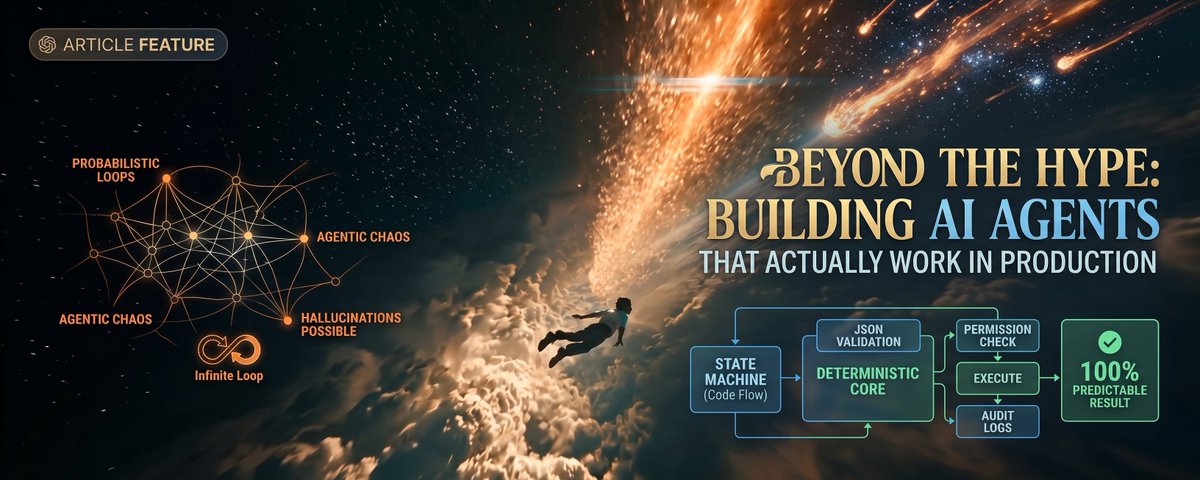
Beyond the Hype: Building AI Agents That Actually Work in Production
We’ve all seen the magical AI demos. You type a vague prompt into a chat box, and a few seconds later, an "autonomous agent" writes a marketing plan, codes a website, and emails a client. It looks
Out of a quiet obsession, we built a beast. 60+ heavy utilities, handed freely to the web.
A few months ago, Launch Your Concept released a beast. 60+ massive utilities operating entirely off the grid.. Inside the engineering madness that built FlashTools. We were tired of the web feeling