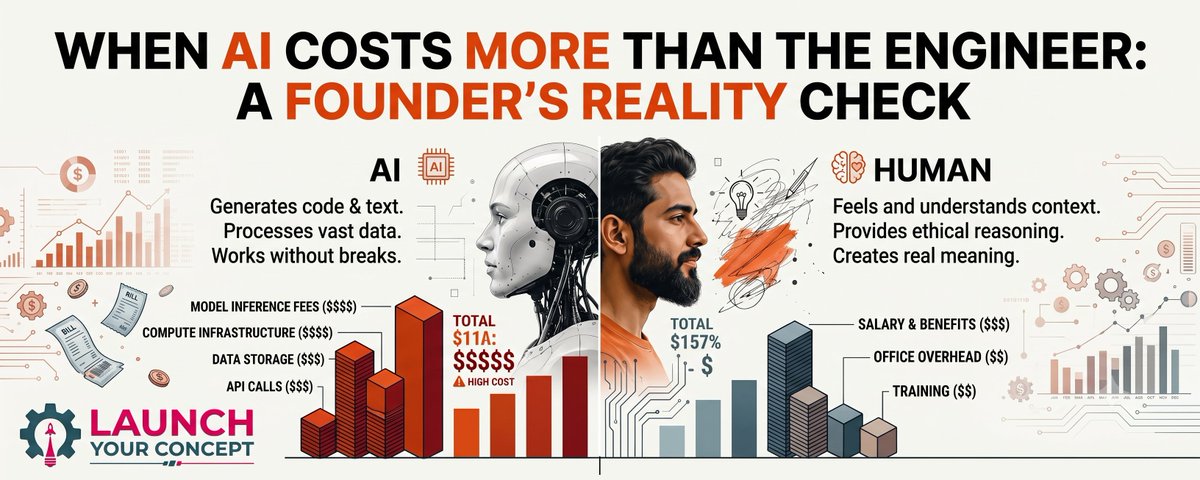
When AI Costs More Than the Engineer: A Founder's Reality Check

For the last couple of years, the story around Artificial Intelligence has been entirely about efficiency: AI writes code faster, answers support tickets instantly, and replaces expensive human labor with cheap API calls.
But if you look at production environments today, the math has inverted. Companies are realizing that deploying advanced AI isn't inherently cheaper. In fact, if not architected correctly, the AI itself can cost more than the human engineer who built it.
- The Simple Explanation: Why is AI Getting So Expensive?
To understand why this is happening in plain English, we have to look at how we use AI today versus a year ago.
Yesterday's AI was a Chatbot. You ask a question, it reads your question (Input Tokens), and it gives you an answer (Output Tokens). It is a single, predictable transaction.
Today's AI is an Agent. You don't just ask an agent a question; you give it a goal. Imagine you ask an AI to "Find all failed payments today and refund the ones caused by our server outage."
- The AI writes a database query.
- The query fails because of a typo.
- The AI reads the error, realizes its mistake, and rewrites the query.
- The database returns 500 rows.
- The AI reads those rows, filters them, connects to your payment gateway, and issues refunds one by one.
Every single time the agent takes a step, makes a mistake, or tries again, it has to re-read the entire conversation history up to that point so it doesn't lose context. This is like forcing an employee to re-read the entire company handbook every time they send an email. Because of this compounding reading load, a multi-step agentic workflow consumes 5 to 30 times more tokens per task compared to a standard chatbot.
When millions of users start triggering these agents, your cloud bill explodes. You are no longer paying just for answers; you are paying for the AI's internal thought process, its mistakes, and its retries.
- The Reality Check: The Data Behind the Burn
This is not a theoretical, five-years-in-the-future problem. It is actively killing unit economics right now.
At the absolute frontier of AI development, infrastructure costs have completely eclipsed human capital. Anthropic, one of the leading AI labs, currently spends 2.3x its payroll on compute—roughly $515,000 per engineer per year in compute costs against a $224,000 fully-loaded senior engineer salary.
While that is an extreme example of a company training models, the consumption crisis is hitting enterprise and consumer startups just as hard during inference (the act of querying the model in a live app).
- The Big Tech Burn: Uber managed to burn through its entire 2026 budget for AI coding tools in just four months. As adoption of tools like Claude Code jumped across their 5,000-engineer organization, monthly API costs per engineer spiked to between $500 and $2,000.
- The Startup Death Spiral: A fintech startup deployed a fraud-detection agent that cost $5,000 a month for 50 users. When they scaled to 500 users, the cost didn't scale linearly—it tripled to $15,000 a month. The unit economics inverted, and the project had to be shut down.
Goldman Sachs projects that as we fully transition from chatbots to agentic workflows, global token consumption will increase 24-fold by 2030, reaching 120 quadrillion tokens per month.
The per-token cost of intelligence has actually dropped massively since 2024, but total enterprise AI bills are still rising. Why? Because the sheer volume of tokens consumed by agentic loops outpaces the price deflation of the APIs themselves.

- The Architecture Shift: The "Token-Budget" Mindset
If you are a founder, CTO, or full-stack engineer, you can no longer afford to build with a "features-first" mindset where you simply pass data to the smartest model available (like GPT-4o or Claude 3.5 Sonnet) and hope for the best.
You must adopt a "Token-Budget" mindset. This means treating AI tokens exactly like database reads/writes, bandwidth, or memory allocation.
The Re-Sent Context Problem: The biggest architectural flaw in modern AI apps is the stateless agent loop. Here is the typical, expensive retry mechanism:
- An agent queries a database. It times out or returns bad data.
- The agent decides to retry.
- The application re-sends the full conversation context plus the new tool invocation.
- A simple three-retry loop on a single database read just tripled the token cost for that single step.
Furthermore, researchers found that identical agents running the exact same tasks can have a 30x variance in token costs depending on the specific trajectory the agent decides to take. You cannot effectively run a business when an API call might cost $0.05 or $1.50 for the exact same user request.

- Deep Dive: Architecting for Cost-Efficiency
To fix this, we have to engineer at the intersection of model selection, state management, and strict observability. Let's break down the three pillars of a cost-optimized AI backend.
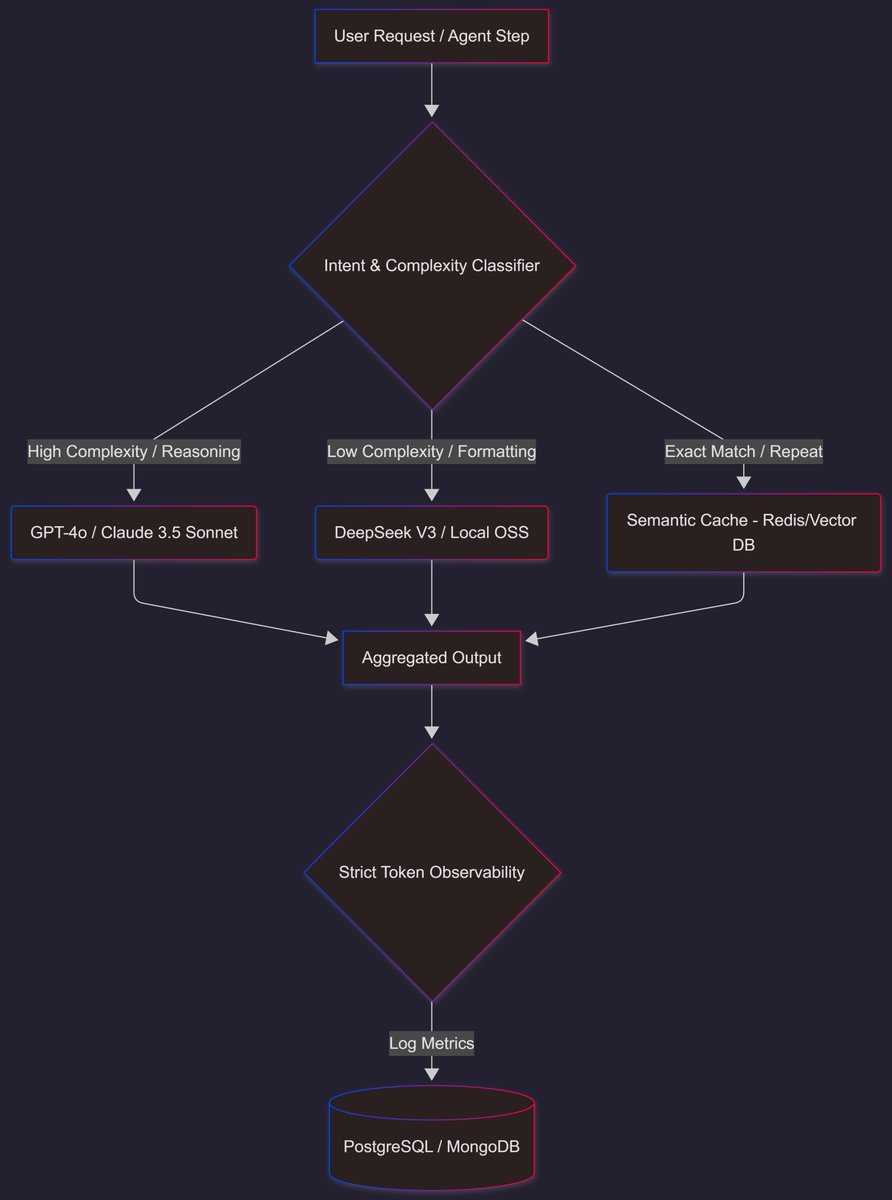
Pillar 1: Smart Model Routing (Tiered Intelligence)
You do not need a frontier model to parse a JSON payload or classify user intent. Modern systems must route requests dynamically based on task complexity. Open-weight models like DeepSeek V3 are currently delivering frontier-comparable benchmarks for specific tasks at 1/10th to 1/30th the API cost of leading proprietary models.
Here is how a dynamic routing architecture should look in production:
Pillar 2: Token Observability Middleware
You cannot optimize what you cannot measure. Most teams track their overall monthly OpenAI/Anthropic bill, but they have no idea which specific feature is burning the cash.
You need to inject middleware into your Node.js or Python backend that calculates the real-time cost of every single AI call and tags it to a specific feature, user, and agent run.
Here is a robust TypeScript implementation for tracking AI usage:

Pillar 3: Stateful Agent Checkpointing
To solve the "Re-sent Context Problem", you must replace stateless agent loops with stateful checkpoints.
Instead of passing the entire array of previous messages back to the LLM every time a tool fails, you summarize the state, save it, and only pass the necessary delta. Implementing checkpointing can cut token usage by 40%+ on long-running tasks.
- Strategic Takeaways for Founders
The goal isn't to stop using AI; the goal is to shift your unit of measurement. Stop measuring "cost per token" and start measuring "cost per accepted outcome."
If a cheaper model gets stuck in an infinite loop and burns 50,000 tokens failing a task, it is ultimately more expensive than a premium model that completes the task on the first try using 2,000 tokens.
To survive the agentic era, implement these three rules today:
- Kill the default setting: Never default your entire application to the most expensive frontier model. Route simple logic to cost-effective models immediately.
- Cap the retry loops: Hardcode strict limits on how many times an agent can attempt a tool call before escalating to a human or throwing an error. Do not let agents run stochastic, unpredictable loops in the background.
- Track feature-level margins: If your user pays you $20/month for a SaaS tool, but their agentic usage costs you $25/month in compute, you don't have a software company; you have a charity for cloud providers.
The winners in this next phase of software engineering won't just be the teams with the smartest prompts. The winners will be the engineers who architect their AI workflows to be as ruthlessly efficient as their database schemas.
Have thoughts or questions on this topic?
Follow and discuss with our engineering team on X / Twitter for daily tech breakdowns, system design notes, and software engineering debates.
Related Articles

Your Phone Was Always a Better Remote Control . NEXORA Just Made It Feel Like One
I never noticed how frequently I reached for the mouse until I began keeping count. Lean in, click, lean back, open a tab, skip a track, type six words—and repeat the loop dozens of times an hour. The
Beyond the Hype: Building AI Agents That Actually Work in Production
We’ve all seen the magical AI demos. You type a vague prompt into a chat box, and a few seconds later, an "autonomous agent" writes a marketing plan, codes a website, and emails a client. It looks

Out of a quiet obsession, we built a beast. 60+ heavy utilities, handed freely to the web.
A few months ago, Launch Your Concept released a beast. 60+ massive utilities operating entirely off the grid.. Inside the engineering madness that built FlashTools. We were tired of the web feeling